
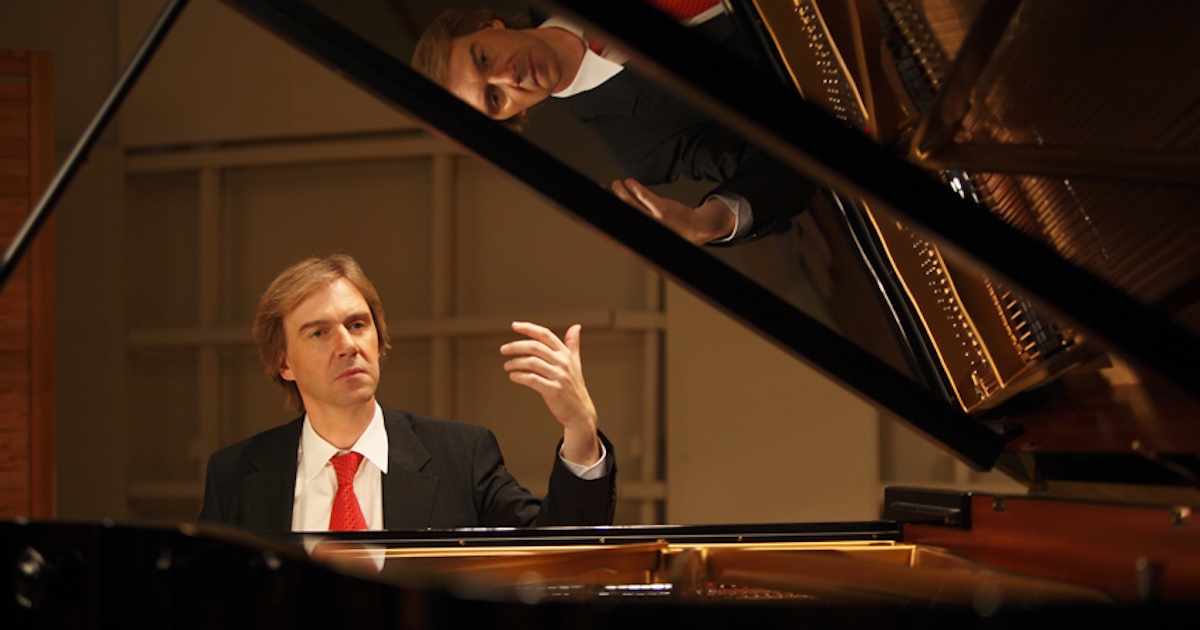
Burkard Schliessmann Interview
23 March 2026 Featured Music Interviews
A December 14 2025 Interview with Burkard Schliessmann on KUCI’s Classical Impacts with Isabella Cao
Isabella Cao: Alright, so, my first question is, in your album, you recorded on two pianos. What made you choose between playing some pieces on a particular piano and some pieces on the other piano in your album?
Burkard Schliessmann: Yes, it’s an excellent question, because, let me say, we had really an excellent Steinway concert, provided by Daniel Brech, and we had one piano concert, but two keyboards. And let me say, this can be seen above all, then, that the piano I had, two pianos and the two keyboards really had been totally different. And one had been very brilliant, the other one had been really been in a very warm… let me say, voicing and intonation. And by a flying case, we changed both keyboards, one to another, and all the pieces I played we had divided up on these two keyboards. It’s really sensational, and the great acoustics of the Teldex Studios in Berlin provided us a really exceptional sound, and this is really exceptional.
Isabella Cao: Yeah, that’s really amazing. I don’t really see a lot of albums that record on two pianos, so I’m really glad you made the distinction between them, and also [how you] merged those into your album, which is really, really amazing to see. And this is related to your next album, so if you could choose a piano to record on, which one would you choose? Would you choose the same one or a similar one that you did in Teldex Studios?
Burkard Schliessmann: Yes, a reflection to our last and recent conversation, to my “Live and Encores” we had FAZIOLI in a really, let me say, in the concert hall of Sacile in Italy. It’s a really small hall, and a really large concert hall, which provides a very intimate sound. So, now, with this recording, we had a very large conversation in a really big hall and big studio, and so Julian Schwenkner, which really provided us [with a] nice septal sound, as our technician. There we had the opportunity, that I could divide, between the pianos, let me say, between one and the other one, and so we had really an exceptional sound for the voicing of the two keyboards, and incoherence to the hall itself, because a studio in Berlin, the Teldex studio, is exceptional in voicing, and repeated to my interpretation in a very, very special way of sound.
Isabella Cao: Yeah, that’s really amazing. So, I know when you’re recording, there’s a lot of microphones, and could you tell our listeners about each microphone, [such as] what is the purpose? When you’re angling the microphone inside or near the piano, what kind of a sound do you want to make and express with all of that? [from a pianist point of view]
Burkard Schliessmann: Absolutely, yes. And, the 14 microphones provided us a special atmosphere of the whole interpretation of myself. It’s really provided in a special and reflected in a special voice of sound. Our conversation with the studio and Julian Schwenkner of the producer, and myself as an interpreter, and an artist, and pianist. So, we used these 14 microphones to provide, let me say, Dolby Atmos, yes. This is one point. The other point is that, first, we released these interpretations in a SACD, and now we go to vinyl. And this is a point in an age dominated by digital streams and compressed audio files, the vinyl LP stands as a monument to sensuality and authenticity. It is far more than a mere sound career. It is an experience, a ritual, a work of art, anyone had let me say, ever placed this stylus upon the black gold knows: And vinyl is both nostalgic and future. Bridges Generations tells stories and turns music, the stage, it’s so richly, deserves for those who wish not merely to hear music, but to experience it. The record is an [example], really a treasure for most listeners. And this is the secret of this edition.
Isabella Cao: Yeah, that’s really amazing, thank you for sharing that. So, with this album, I know you also recorded a Robert Schumann Fantasies album, previously. And this is the vinyl version we’re talking about today, and what did you want to capture differently with this album in contrast with your previous album?
Burkard Schliessmann: Yes, it’s really something special, because, let me say vinyl, it’s a new way, not only for future, it’s only a reflection of something we already had. But let me say, in a new way for new listeners. And, let me say that, music must breathe. It must speak to the soul and not just to the ear. And this is a way I want to pay out and to point out for the listeners and my clients with this addition. This is a way.
Isabella Cao: Wow, that’s amazing, and just a follow-up question to that, I guess more so about interpretation—how do you bring your own voice to these iconic works without losing the composer’s intent? You’ve done it so masterfully, but just [explaining the process] from a pianist’s point of view.
Burkard Schliessmann: Yes, because Schumann itself, and himself, it’s really a part of myself, and the explosion and the internal voices to point out. Already had been a challenge for me in my, let me say, earliest youth. And this now, in reflection, let me say, by working on these pieces for so many, many years. to say yes, and to know, yes. This had now been the workout for the new interpretation of this interpretation and this edition now. And this is really a part of myself.
Isabella Cao: Yeah, that’s really amazing, I totally agree that sometimes when you’re playing a work for a long time, you discover more and more about it, and it’s just really amazing to see that unfold in this album. And particularly on this album, is there a piece or, a group of pieces that changed meaning for you when you were recording this again?
Burkard Schliessmann: Absolutely, yes. Especially, the, let me say, the Fantasy in C major, because, I, let me say, I played it some months ago, live, in our recent conversation, in Live and Encores, on the FAZIOLI, in the Fazioli Concert Hall, in the Sacile, in Italy. Now, I played it some months again. new way in, let me say, in the studio of, Berlin, of Teldex, with my new producers and so on, and especially, you can hear the difference, in the that movement, because I used the way of the studio, which provided us a new way of sound, which provided us, let me say, much more space. And therefore, I interpreted it In a specially new way of sound. And especially also in tempo and speed, because this interpretation is a new way of my own. And, the fantasy now in Berlin is totally different than the fantasy of the major of Schumann in, let me say, in Italy, on my property, piano, on a FAZIOLI, because…The acoustics, provided to me a new challenge. A new challenge of sounds, and this is the way of interpretation. The reflection of my internal voicing from the piano itself, and the community with my producer, Julian Schwenkner had been a total different way of interpretation, and therefore, you can’t combine both interpretations. It’s totally different. One can say, I provide this way, or I provide this way, yes? But my personal way is the early interpretation of Berlin.
Isabella Cao: Yeah, wow, that’s really incredible. I’m really amazed by that as well, and I was also wondering, in your creative process, do you use Schenkerian analysis? Or do you know any other pianists and colleagues who use that actively?
Burkard Schliessmann: Absolutely. I already heard to Nelson Freire, of course. and Claudio Arrow. But lastly, it’s my own way of interpretation, because every artist has to find a new way of interpretation, and a new way to who may…Make a reflection to the audio and to the… to the listener. And this is very, very important.
Isabella Cao: Yeah, I totally agree with that, and that’s exactly why you made this album again, and it’s just to really show the reflection of these pieces in such a new light, and it’s really amazing to hear. So to all the listeners, I encourage you to listen to all the pieces in this album! I was wondering what piece, or a set of pieces, in the album means the most to you? I know you love all of the pieces, and could you elaborate a little bit more on why?
Burkard Schliessmann: Absolutely. The Kreisleriana, of course. I record it, really, several times. Now, I got it. Let me say to… I have to confess, I had worked so many years for it. Now, it is really on a special way, and, because the electricity of my… new interpretation of Kreisleriana is something, let me say, excuse me, something definite. In my own…And, also, let me say, the Gesänge der Frühe, the Songs of Dawn, it’s something, let me say, I worked so many years for it, and you have to keep in mind that, really, the great, interpreters and the piano long ago to me, let me say, Claudio Arrow and Wilhelm Kempff, which are not, living more, unfortunately, they, didn’t, interpret these, Songs of Dawn, because essence to this interpretation, and to this, let me say, to this, way of life from Schumann is so difficult that they lay…: It aside, because the sentence to these pieces is very, very difficult. And you have to… you need many, many hours and many years to communicate to these pieces of Gesänge der Frühe, or especially to the Nachtstücke, the Night Pieces. The access to these pieces is very, very difficult. Because they are really not especially composed for the piano itself. They are really, let me say, something from the inside from Schumann itself. And this is a point, in coherence and in opposite to Kreisleriana or to Fantasy in C major.
Isabella Cao: Yeah, those two, and all the pieces that you described are really breakthrough pieces, and definitely one of the pieces that you often hear, but your recording is really, really valuable and special. I really treasure it. [Next question] And this is more so when you’re recording—was there a moment in the studio that didn’t go as planned, or something that you weren’t expecting, but it was really valuable when you’re recording?
Burkard Schliessmann: Yes, it’s a new way of sound, let me say. Because, it, has been a special way of, coherence and, discussion with my, Julian Schwenkner, my, sound producer, because the communication with the producer, this is very, very essential, and therefore, this is, let me say, a secret of a great communication and of a great addition of, of, of work, yes.
Isabella Cao: Were there any key ideas that worked, like, particularly well in the making of the album? Or any thought process?
Burkard Schliessmann: Yes. Yes, it’s a really, a new way with the vinyl, and as already pointed out, let me say, it’s a challenge for all of us to communicate with the audience.
Isabella Cao: Yeah, I definitely agree, because the audience might have a different image due to subjectivity in the music, and if you have something that you’d like the audience to remember, or you hope that they really want to… what you hope the listeners feel or discover, what would it be?
Burkard Schliessmann: Yes, I hope that they will discover the new way of my interpretation, and the… especially the insights of my interpretations of the inner voices of the Schumann works I played. I didn’t point out only the electricity and the bitosity, but I especially pointed out the internal voices. And so, we have a real, let me say, coherence between the out voices and the inner voices of the music itself. And this is the real challenge of Schumann, because the internal voices and the internal sounds of the music itself, and really in reflection to the library. And, let me say, to the poetics of Schumann. This is the special way, because Eichendorff and all the great literates of Schumann, who inspired him. This is the way we have to understand the Schumann, and the Schumann has to inspire and to learn by, let me say, by the literature. German literature, and this is the way we have to include the internal voices and, let me say, the interpretation. And therefore, it’s a special channel. Yes, absolutely, yes, because, you have to understand Schumann, this is songs, and, the literature of Schumann, who had inspired him, it’s a real way, it’s a special way of communication with himself, because the explosion of the internal voices is really something that special, and Schumann had been all the times in his life, and also had been a composer of, let me say, of songs, and in communication, the songs’ voices. With the piano, and this is the way we have to understand him.
Isabella Cao: Yeah, totally agree with that! This is for your next album—do you have any plans for what’s next? Are you going to focus on another composer, similar to how you did the Schumann albums, or more so a lot of different composers into one album?
Burkard Schliessmann: Yes, I really, as you know, Chopin is, for me, the climax of all, composers. And, let me say, I will… record the preludes again in a new way. Because I already recorded them in 2015, and now it’s a new challenge for me, because I, in my personal reflection, I learned that I have a new challenge in my personal life. And my personal life. All… also had been changed. And therefore, therefore, I reflect in new interpretation, and new voices, and new colors. And therefore, I mean that the Chopin Preludes, it’s really a special way of voicing.
Isabella Cao: I’m really looking forward to that album, and totally will be on the lookout for it as well. Hopefully we can talk again about it, just like we did for this album.
Burkard Schliessmann: Yes. Absolutely, yes. Yeah. Oh, it’s a special way. Yes, I hope that, my clients will like this new way of interpretation, and it’s really a special way, of this new album on vinyl, because vinyl, as pointed out is, something special in reflection of the old way of, let me say, of, Robert Schumann and now, in a new way, also of Robert Schumann, to point out, let me say, the internal voices.
Isabella Cao: Yeah. I really like how you mentioned the internal voices, because although I haven’t played the Schumann Fantasy Op. 17, one of my peers have played it, and they were talking about, you know, how there’s Clara’s theme at the end, and there’s also so many different themes throughout the piece, and it’s really cool to hear those all tied together.
Burkard Schliessmann: Yes. Absolutely, yeah.
Isabella Cao: I was wondering, before you go into a piece, do you outline, like, where you want certain things, outline all the themes before you play, or when you’re practicing, you kind of just do it at the same time?
Burkard Schliessmann: No, it’s really something, let me say, inspired by intuition. let me say, I have really, by first point, an, a way to the… by my own intuition to these works. And I’m inspired, inspired by this. And, let me say, a second point is now to learn the internal structures. It’s the last way I come back to the intuition.
Isabella Cao: Yeah. Intuition is really, really cool, too, like, when you’re playing.
Burkard Schliessmann: Absolutely, yes. Also, improvisation is combined with the intuition and improvisation It combines all of this. These aspects, and this is the secret, let me say, of a real great interpretation: Of a mass special interpretation.
Isabella Cao: Yeah, totally. And then you also have the composer to guide you along, so you won’t really worry.
Burkard Schliessmann: Absolutely. Because you have to find, especially by, to point out, let me say. if you… Sorry. It’s okay. When you’re… when you’re, played once and knew way you have… To point out in a new way, and It’s really very, very difficult, a new way to fight by yourself. And this is… Improvisation.